
November 19, 2025
by Jackie DiBartolomeo of Richmond Biz Sense
The Virginia Home has broken ground on its new home.
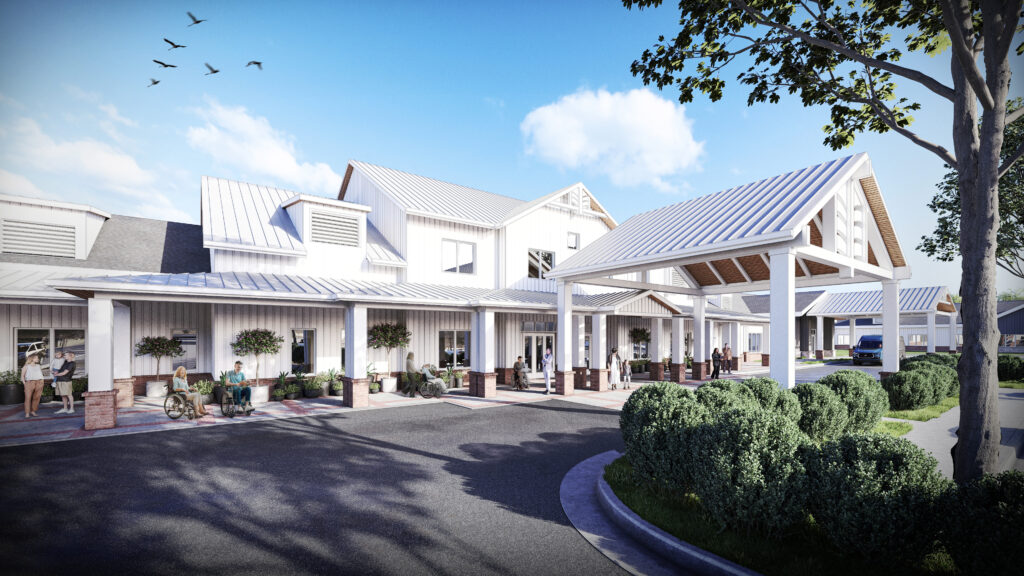
The local nonprofit on Tuesday held a ceremonial groundbreaking for its planned $128 million facility for residents with disabilities to be built near the intersection of Pole Green and Bell Creek roads in Hanover County.
Formal construction is now set to begin, with an expected completion in late 2027.
The new 196,000-square-foot complex will replace the Virginia Home’s current six-story Byrd Park home at 1101 Hampton St. in Richmond, where it has been located for nearly a century. That property is under contract to D.C.-based developer Audeo Partners, which plans to convert it into a 131-unit apartment building.
The new 160-bed Virginia Home will mean increased capacity for the nonprofit, as its 130 beds in the city are currently at full capacity. It also will offer increased room sizes of roughly 270 square feet, up from around 160 square feet rooms on Hampton Street.
The facility will also have wider hallways, and, being a one-story building instead of six stories in Byrd Park, will be more easily accessible without elevators, said Laura Stewart, chair of the Virginia Home’s board of trustees, adding that the current facility’s elevators often stop working and cause long wait times for residents.
With the added capacity, the nonprofit will also launch a 60-person day program for those who are disabled and want “respite, fun and social activities for a few hours a day.” Stewart said that as far back as the 1970s, the nonprofit has been interested in implementing a day program, adding that it could create some new social circles for caretakers and those with disabilities.
Virginia Home CEO Doug Vaughan Jr. said project costs are estimated at $128 million, for which the nonprofit is currently fundraising. Stewart said it has around $15 million to $20 million left toward its fundraising goal.
The Virginia Home paid $8.7 million late last year for the 70-acre site in eastern Hanover where the new facility will rise. It’s adjacent to the Food Lion-anchored Shoppes at Bell Creek.
Gilbane is the project’s general contractor. Architecture firm Baskervill is handling the design.
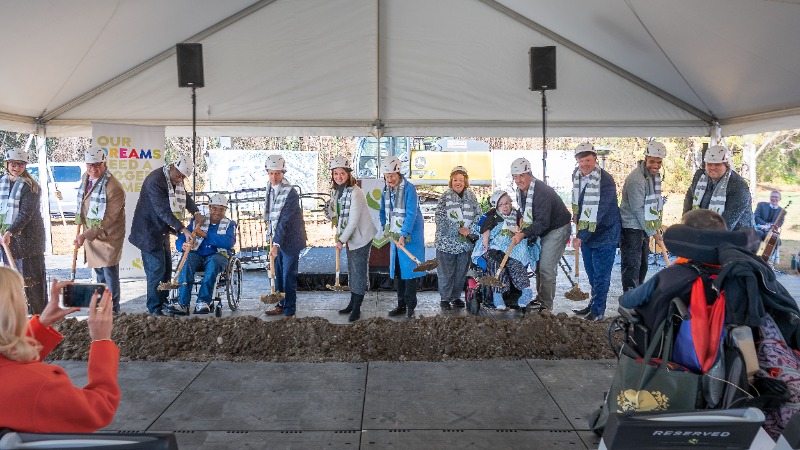
Vaughan and Stewart, among others, picked up their hardhats and shovels to move ground Tuesday morning to celebrate the beginning of construction on the new facility. They were joined by State Sen. Ryan McDougle and Hanover County Supervisor Sean Davis at the groundbreaking.
“Our residents will have more room, more natural light and no elevators,” Stewart said in a speech at the groundbreaking, to laughs and cheers from the crowd.
Al Allen, a Virginia Home resident and president of the resident council, echoed that excitement.
“(This) represents much more than just a new building. It means we have no more long waits for the elevators … greater freedom to move easily through our home, we have big windows with lots of natural light,” Allen said at the event.
Virginia Home was founded in 1894 by Mary Tinsley Greenhow as “The Virginia Home for Incurables” as a residential care facility for disabled adults. It first opened on Ross Street in the city with eight residents, and later moved in 1898 to a building at West Broad and Robinson streets.
Since 1930, the nonprofit has been located in the Hampton Street building, and its name was shortened to the Virginia Home in the 1960s. The nonprofit operated with $40.6 million in revenue and $24.6 million in expenses in 2024, per the nonprofit’s most recent public financial reports issued to the IRS.
Virginia Home will continue to operate in its Byrd Park facility until it completes its move to Hanover, while Audeo Partners continues its planning for the Hampton Street building’s redevelopment in the meantime.
Audeo partner Madi Ford said the property would receive “minimal façade alterations,” and that its new incarnation as an apartment building would be called “The Tinsley,” in honor of Tinsley Greenhow.
The Tinsley would have an income-based element, with 30% of its units available to those earning up to 80% of the area median income, Ford said.